The Problem
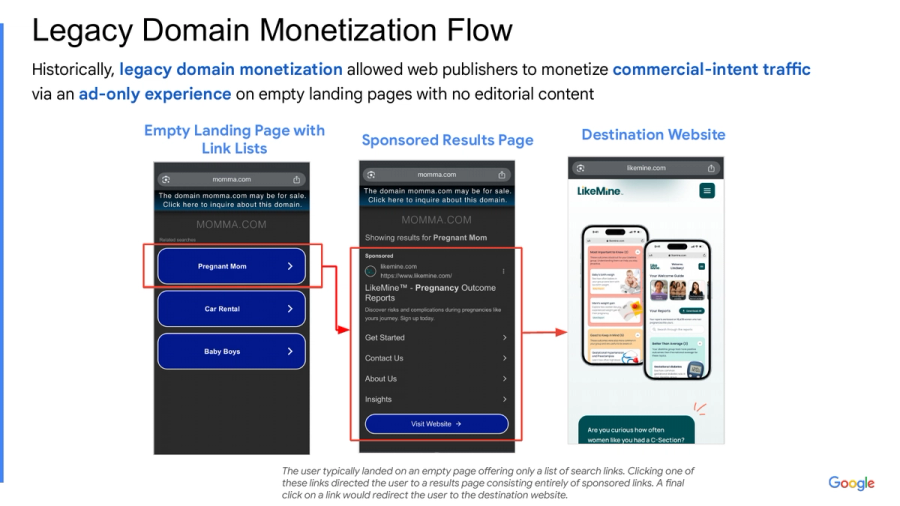
A major search network moved to restrict ad serving on content-light pages to protect ecosystem health, a policy shift that put high-intent, high-value type-in traffic at risk. Thousands of legacy parked domains had no real content and no on-site search, just a page of sponsored link lists that sent visitors straight to an external site. Once that ad model was restricted, publishers stood to lose the monetization stream entirely, with nothing built to replace it.
What We Did
As Product UX Strategist, we mapped the full journey for Liam, a persona representing direct-navigation searchers who type a domain straight into the address bar expecting an immediate, relevant result. Research confirmed these visitors are highly intent-driven: land them on a contentless page and they leave within seconds. We designed a content-integrated search model that replaces the empty landing page with a real editorial homepage, embeds contextual search cards directly inside articles, and keeps the entire experience, from article to search results, hosted on the publisher's own domain to preserve user trust. High-fidelity wireframes and a working prototype walked legacy publishers through exactly how their monetized traffic would flow under the new model.

The Solution
An editorial homepage that replaces the empty link-list landing page, articles with embedded search cards that surface related topics without leaving the page, and a fully integrated search results experience that stays on the publisher's own domain end to end. The flow was built with accessibility as a baseline: high-contrast text, large tap targets on every search chip, and a layout simple enough that users never lose track of the search bar.
Outcome
A complete, compliant search experience ready to pitch to legacy publishers, showing exactly how their existing traffic converts into on-site engagement instead of an immediate bounce. The mockups gave publishers a concrete before-and-after: from an empty page with three link buttons to a real homepage, article, and search journey that keeps users, and monetization, on their own site.